"What do you do?"
This is nearly always among the first questions we are asked (or that we ask) when we meet a new acquaintance. Appearance may form our initial impression of a person, but we want to know what they do in order to assign them a lasting place in our mental hierarchy. The answer conveys important social information about the person.
It signals their probable wealth, social status, perhaps the neighborhood they are likely to live in, and we may even project what we expect their house and car to look like. If I tell you, "I'm a doctor," your mind immediately places me in a certain size house, maybe with a sports car, probably with certain other status markers. If I tell you, "I'm a delivery driver," your mind immediately draws different conclusions.
We form these little judgments and opinions not only about the people we meet, but about ourselves as well. Anyone who works for a big company, unless you are a C-level executive, probably wrestles with self-image problems about his job. This is because big companies have splintered work into such tiny pieces that it is very difficult to describe what any one job is. Thus "Chief Financial Officer" is easy to understand, but "Financial Analyst in the Resource Evaluation and Recovery Group" conveys very little information to people you meet outside your company, and leaves them fuzzy about what exactly it is that you do. They therefore have trouble fitting you into their mental hierarchy. Is that better or worse than the friend they have who is an "Assistant brand manager for card processing products"? And if others are confused about our identity, then we get confused about our identity. This explains the people you meet who answer the question with a more general, "I'm in marketing," or "I'm in banking", which at least allows you to form a more clear picture of where they rank.
The trouble with all of this is that it means we form opinions of our acquaintances on gross generalizations and summary stereotypes about only a portion of someone's life. We may summarily dismiss very worthwhile people because "he works for the government" (stereotype: he's lazy) or "she's an accountant" (she's boring). When we turn these generalizations onto ourselves, we fall into the trap of defining our entire persona based on our work. While it is true that most of us must spend more time at work than doing anything else, it should not naturally follow that therefore work is the most important thing in our lives.
I work in an industry, finance, which has undergone constant change and upheaval over the past ten years. I have seen many co-workers laid off in restructurings and reorganizations, and even was displaced once myself. In my experience, the ones who are most resilient through the process are those whose self-identity consists of much more than what they do. When they ask themselves the question, "What do you do?", the answer is "I'm a painter," or "I'm a mother," or "I'm a biker" first, after which comes a job to make money.
Who are you? Yes, your career is important, but it will come to an end some day, perhaps at a time of your choosing, or perhaps at a time you don't choose. If you let your career define you, then that day will be the end of you; not your physical death, of course, but you will be adrift in the world, unsure of who you are, like a teenager trying to figure out where to fit in. Don't let that happen to you; be an interesting person, defined by a host of activities, relationships, and interests--in addition to a career.
Try this the next time you meet someone: don't ask them what they do. Instead, ask "What did you do last weekend?" or "Where are you going for vacation this year?" If they ask you what you do, answer first with a hobby: "I play guitar, and to make money I'm a banker." The conversation that follows should be much more interesting than "So how's work?", and it will teach you to value other people, and yourself, for who they are, not where they work.
Tuesday, December 1, 2009


Friday, November 13, 2009
Waste Not, Want Not
It was a sad week for my extended family as we gathered in Charlotte to lay to rest my cousin Amy's husband, Mike. Only 45 years old, he died from malignant melanoma barely three years after it was first diagnosed in one of his toes. He leaves behind my cousin and their three teenage children.
In the funeral sermon, Amy's brother, Steve, recalled a prayer offered by Mike this past January after learning the cancer had spread throughout his body, and having been given 9-12 months to live. "Lord, help me not to waste my cancer." It was a selfless prayer; recognizing that he was going to be unable to escape his fate, Mike sought some useful purpose for his cancer. By all accounts he found one, using the months he had left to spend lots of time with his family, reconnect with friends near and far, and to inspire others with God's love the best he could to all he met. He did not waste his cancer.
I am impressed with Mike's attitude and inspired by the example he set. Too much of my daily life is spent wanting something: a promotion, more pay, a bigger house, a better car, a nicer TV, more time, etc. All that focus on wants makes contentment hard to come by, since I am always noticing what I don't have. Wants create more wants in a never-ending cascade of greed and envy. As Epicurus wrote: "Nothing satisfies the man who is not satisfied with little."
But as Mike demonstrated, the key is to take what you have and do the most you can with it. Sadly, Mike didn't have nearly as many days on this earth as any of us would want; but he made the absolute most of the ones he did have, and the world is a better place for it. He did not waste his days, and in the end he did not need any more days to have had a full life. Waste not, want not.
Don't waste your life. Don't waste your job. Don't waste your spouse, your kids, your friends, your money, your time. Use what you have to live a full life, today, and every day. Be defined by what you do, not by what you want. Wants will never fully go away, but they need not control our lives. Don't take for granted, or waste, the opportunities and blessings you already have, and perhaps the wants will seem less important.
Waste not, want not.
In the funeral sermon, Amy's brother, Steve, recalled a prayer offered by Mike this past January after learning the cancer had spread throughout his body, and having been given 9-12 months to live. "Lord, help me not to waste my cancer." It was a selfless prayer; recognizing that he was going to be unable to escape his fate, Mike sought some useful purpose for his cancer. By all accounts he found one, using the months he had left to spend lots of time with his family, reconnect with friends near and far, and to inspire others with God's love the best he could to all he met. He did not waste his cancer.
I am impressed with Mike's attitude and inspired by the example he set. Too much of my daily life is spent wanting something: a promotion, more pay, a bigger house, a better car, a nicer TV, more time, etc. All that focus on wants makes contentment hard to come by, since I am always noticing what I don't have. Wants create more wants in a never-ending cascade of greed and envy. As Epicurus wrote: "Nothing satisfies the man who is not satisfied with little."
But as Mike demonstrated, the key is to take what you have and do the most you can with it. Sadly, Mike didn't have nearly as many days on this earth as any of us would want; but he made the absolute most of the ones he did have, and the world is a better place for it. He did not waste his days, and in the end he did not need any more days to have had a full life. Waste not, want not.
Don't waste your life. Don't waste your job. Don't waste your spouse, your kids, your friends, your money, your time. Use what you have to live a full life, today, and every day. Be defined by what you do, not by what you want. Wants will never fully go away, but they need not control our lives. Don't take for granted, or waste, the opportunities and blessings you already have, and perhaps the wants will seem less important.
Waste not, want not.
Tuesday, October 20, 2009
The Return of the Sun
After seemingly weeks of interminable rain in the Atlanta area, we were blessed with a sunny day yesterday. The sight of the sun after so long brought out the poet in me, so with apologies to all serious poets, I share with you:
The Return of the Sun
It was just when I knew
the heavens would never appear blue
during the day again,
my life to be spent in the rain
getting wet, drying off, getting wet.
I was resolved to my fate
when on a cold October morn
a bright yellow orb appeared, shorn of
the cloudy halo of many days passed.
At first thinking I was deceived
by a light in the trees, I walked out
under the green canopy and found,
in the gaps between the fading leaves
and the sturdy branches, that
there was not just sight-giving light
but life-giving warmth!
As small voices squealed under the canopy
I came to know something renewed:
The heavens are blue today, and with
my smile shining and my touch warming,
I will be like the sun.
The Return of the Sun
It was just when I knew
the heavens would never appear blue
during the day again,
my life to be spent in the rain
getting wet, drying off, getting wet.
I was resolved to my fate
when on a cold October morn
a bright yellow orb appeared, shorn of
the cloudy halo of many days passed.
At first thinking I was deceived
by a light in the trees, I walked out
under the green canopy and found,
in the gaps between the fading leaves
and the sturdy branches, that
there was not just sight-giving light
but life-giving warmth!
As small voices squealed under the canopy
I came to know something renewed:
The heavens are blue today, and with
my smile shining and my touch warming,
I will be like the sun.
Monday, October 12, 2009
BOOK REVIEW: The Pleasures and Sorrows of Work, by Alain de Botton
American culture has come to equate busyness with importance. If you are busy, you must be important. And, conversely, if you are not busy, then you must not be important. Since we seem to accept without question the premise that to be important is good, we therefore create a lot of busyness, and work. As a result, our identities become wrapped up in our work. Think about the last time you met someone new at a party; I'll wager the first question asked was, "So what do you do?"
Indeed, we often act as if what we do is very important to the proper functioning of the world. Memos are crafted on weekends; emails are returned late at night; phones are dialed as soon as the plane's wheels have touched the tarmac, so that we don't waste a precious minute as we do our part to advance the part of Western civilization that is dependent upon the widgets that our company produces. We behave like the sharks in the ocean, that must never stop swimming lest they die, as we rush from one "important" task to another.
Alain de Botton does a marvelous job of slowly letting the air out of our egos about our work in his thought-provoking book, The Pleasures and Sorrows of Work. The book is based on the premise that nearly all of man's activity amounts to nothing in the grand scheme of the universe. Even 10 years from now, no one will know or care whether you get the Fitzsimmons memo to your boss by this Thursday's deadline. Or as de Botton observes:
I know that sounds depressing, but don't let it put you off of this book, because de Botton comes to that conclusion after what I think must have been very enjoyable field work, visiting the practitioners of ten different jobs in a wide variety of industries. Among other pursuits, he spots cargo ships with avid hobbyists; walks the path of high-voltage electricity lines with an engineer; sits with a landscape painter; attends an aerospace trade show; and traces the 52-hour voyage of a tuna steak from a swimming fish in the Indian Ocean to a dinner plate in Bristol, England, in a photo essay that alone is worth the price of the book.
Along the way, de Botton finds much to admire in the work we do. A career counselor is humanely portrayed, a sort of minister in the secular religion of career. Accountancy is shown to be an important part of the modern capitalist system, if a bit of a boring job (about what I would expect). Logistics, especially, seems to fascinate de Botton, and he very compellingly shows it to be the under-appreciated backbone of modern consumerist life. Take that tuna steak, and think about it the next time you are at the market: only fifty-two hours after it was swimming in the Indian Ocean, the tuna had been caught, taken to land, filleted, packed, flown half way around the world, and trucked to a suburban grocery store. I won't soon complain about the price of fresh fish again!
There are many such products that we take for granted--that we expect to be available whenever we want them--without ever sparing a thought for the magic of the markets that have developed to bring them to us. As de Botton observes:
Indeed, we often act as if what we do is very important to the proper functioning of the world. Memos are crafted on weekends; emails are returned late at night; phones are dialed as soon as the plane's wheels have touched the tarmac, so that we don't waste a precious minute as we do our part to advance the part of Western civilization that is dependent upon the widgets that our company produces. We behave like the sharks in the ocean, that must never stop swimming lest they die, as we rush from one "important" task to another.
Alain de Botton does a marvelous job of slowly letting the air out of our egos about our work in his thought-provoking book, The Pleasures and Sorrows of Work. The book is based on the premise that nearly all of man's activity amounts to nothing in the grand scheme of the universe. Even 10 years from now, no one will know or care whether you get the Fitzsimmons memo to your boss by this Thursday's deadline. Or as de Botton observes:
If we could witness the eventual fate of every one of our projects, we would have no choice but to succumb to immediate paralysis.In this view, the self-importance that imbues so much of our daily work, that leads us to choke down sandwiches at our desk while we read reports, to travel half way across the country for a one hour sales meeting with someone we don't really like, and to waste countless hours in meetings talking about decisions that need to be made rather than actually making them, is actually a sophisticated form of self-deception, of coping with the fact that we are just tiny meaningless specks in the cosmos.
I know that sounds depressing, but don't let it put you off of this book, because de Botton comes to that conclusion after what I think must have been very enjoyable field work, visiting the practitioners of ten different jobs in a wide variety of industries. Among other pursuits, he spots cargo ships with avid hobbyists; walks the path of high-voltage electricity lines with an engineer; sits with a landscape painter; attends an aerospace trade show; and traces the 52-hour voyage of a tuna steak from a swimming fish in the Indian Ocean to a dinner plate in Bristol, England, in a photo essay that alone is worth the price of the book.
Along the way, de Botton finds much to admire in the work we do. A career counselor is humanely portrayed, a sort of minister in the secular religion of career. Accountancy is shown to be an important part of the modern capitalist system, if a bit of a boring job (about what I would expect). Logistics, especially, seems to fascinate de Botton, and he very compellingly shows it to be the under-appreciated backbone of modern consumerist life. Take that tuna steak, and think about it the next time you are at the market: only fifty-two hours after it was swimming in the Indian Ocean, the tuna had been caught, taken to land, filleted, packed, flown half way around the world, and trucked to a suburban grocery store. I won't soon complain about the price of fresh fish again!
There are many such products that we take for granted--that we expect to be available whenever we want them--without ever sparing a thought for the magic of the markets that have developed to bring them to us. As de Botton observes:
Two centuries ago, our forebears would have know the precise history and origin of nearly every one of the limited number of things they ate and owned, as well as of the people and tools of their production. They were acquainted with the pig, the carpenter, the weaver, the loom and the dairymaid.....We are now as imaginatively disconnected from the manufacture and distribution of our goods as we are practically in reach of them, a process of alienation which has stripped us of myriad opportunities for wonder, gratitude, and guilt.Logistics is the enabler of this change, and a result of the change is the increasing specialization of our jobs. De Botton visits the offices of United Biscuits, a company of five thousand souls engaged in the manufacture of cookies and other sweets. We have all baked cookies in our own kitchens, and so understand that there is some meaning inherent in the work of a company baking them. But when that task is subdivided and spread across five thousand people and six manufacturing sites, does it still have the same meaning? Specialization has its benefits, especially in increasing productivity, but at what cost to our personal sense of meaning and accomplishment? Again, de Botton:
It is surely significant that the adults who feature in children's books are rarely, if ever, Regional Sales Managers or Building Services Engineers. They are shopkeepers, builders, cooks, or farmers--people whose labors can easily be linked to the visible betterment of human life.....we cannot help but sense that something is awry in a job title like "Brand Supervision Coordinator, Sweet Biscuits".....But just when it may seem that de Botton's melancholy observations will outweigh his admiration for the work that people do, he makes what I find to be actually an optimistic conclusion: we puff up the importance of our work precisely because we do understand, at some level, that we are insignificant in the universe, that death is our only certainty, and that through our work we can take our minds off that ultimate melancholy thought. In other words, working is life because it takes our mind off of death. De Botton:
The impulse to exaggerate the significance of what we are doing, far from being an intellectual error, is really life itself coursing through us.....To see ourselves as the centre of the universe and the present time as the summit of history, to view our upcoming meetings as being of overwhelming significance, to neglect the lessons of cemeteries, to read only sparingly, to feel the pressure of deadlines, to snap at colleagues, to make our way through conference agendas marked '11:00 a.m. to 11:15 a.m.: coffee break'.....maybe all of this, in the end is working wisdom.So yes, you are important. Yes, that memo has significance. Yes, your sales calls matter. Do your best at whatever it is you do, for in the end we are all dead. Therefore, live while you are alive!
Wednesday, September 23, 2009
Success
The conventional wisdom for career advice in recent months seems to be this: express your thanks that you have kept your job by working even harder to succeed with the fewer resources that are now allotted to your company by the shrunken economy. I don't know where this conventional wisdom came from--probably a convention of employers--but it is a little depressing that the primary response to the worst economic slowdown in the lives of anyone under 50 is not to pause to evaluate whether a change is perhaps desirable--is it possible that our relentless pursuit of more, more, more was fruitless in the end?--but instead to double down and work even harder doing the same things. Yes, most of us need to work to live, but it seems to me the philosophy that work is the source of happiness has taken a beating in the past year or so.
Thus I was refreshed this week when while reading I came across Ralph Waldo Emerson's definition of success:
To laugh often and love much;
To win the respect of intelligent persons and the affection of children;
To earn the approbation of honest critics and endure the betrayal of false friends;
To appreciate beauty;
To find the best in others;
To give of one's self without the slightest thought of return;
To leave the world a bit better, whether by a healthy child, a rescued soul, a garden patch or a redeemed social condition;
To have played and laughed with enthusiasm and sung with exaltation;
To know even one life has breathed easier because you have lived;
This is to have succeeded.
Note that nothing in this definition requires a job to achieve; in fact, a person successful by this standard could work in any field, or none at all. Perhaps that is the point--he or she would not be defined by a job, but instead by the obvious positive results of a lifetime of relationships, experiences, and memories. What a way to live!
Thus I was refreshed this week when while reading I came across Ralph Waldo Emerson's definition of success:
To laugh often and love much;
To win the respect of intelligent persons and the affection of children;
To earn the approbation of honest critics and endure the betrayal of false friends;
To appreciate beauty;
To find the best in others;
To give of one's self without the slightest thought of return;
To leave the world a bit better, whether by a healthy child, a rescued soul, a garden patch or a redeemed social condition;
To have played and laughed with enthusiasm and sung with exaltation;
To know even one life has breathed easier because you have lived;
This is to have succeeded.
Note that nothing in this definition requires a job to achieve; in fact, a person successful by this standard could work in any field, or none at all. Perhaps that is the point--he or she would not be defined by a job, but instead by the obvious positive results of a lifetime of relationships, experiences, and memories. What a way to live!
Thursday, September 10, 2009
Being vs. Doing
My family spent a relaxing Labor Day weekend with our friends at their lake house in the mountains of North Carolina. It was a great trip for everyone: the kids had someone to play with, and the adults had someone to talk to. We spent a lot of time on the lake, pulling the kids on the Great Big Mabel (a giant tube on which they ride, bouncing crazily in the wake). It was a good 15 degrees cooler than in Atlanta, and we reveled in the crisp air.
I realized upon returning that one of the delights of the weekend was the lack of pressure to do something. The weekend wasn't about doing; it was about being. Instead of my usual daily rush of doing--emailing, phoning, cleaning up, shuffling papers, reading memos, all the busyness that makes up life--I got to enjoy just being a father, a friend, a passenger in the boat. We sat a lot; we talked a lot; we watched a little football on TV. We just were. Ask me what I did, and I'd probably answer, "Oh, nothing." But I loved every minute of it; I returned with my mind clear, feeling a little less rushed, appreciating my friends and family a little more.
This week has seemed more rushed than usual. It could be the deal I'm working on, or it could be the contrast between being and doing. I wonder how I can incorporate more being into my daily routine, to balance the doing and bring peace to my endeavors?
I realized upon returning that one of the delights of the weekend was the lack of pressure to do something. The weekend wasn't about doing; it was about being. Instead of my usual daily rush of doing--emailing, phoning, cleaning up, shuffling papers, reading memos, all the busyness that makes up life--I got to enjoy just being a father, a friend, a passenger in the boat. We sat a lot; we talked a lot; we watched a little football on TV. We just were. Ask me what I did, and I'd probably answer, "Oh, nothing." But I loved every minute of it; I returned with my mind clear, feeling a little less rushed, appreciating my friends and family a little more.
This week has seemed more rushed than usual. It could be the deal I'm working on, or it could be the contrast between being and doing. I wonder how I can incorporate more being into my daily routine, to balance the doing and bring peace to my endeavors?
Wednesday, September 2, 2009
Diversions
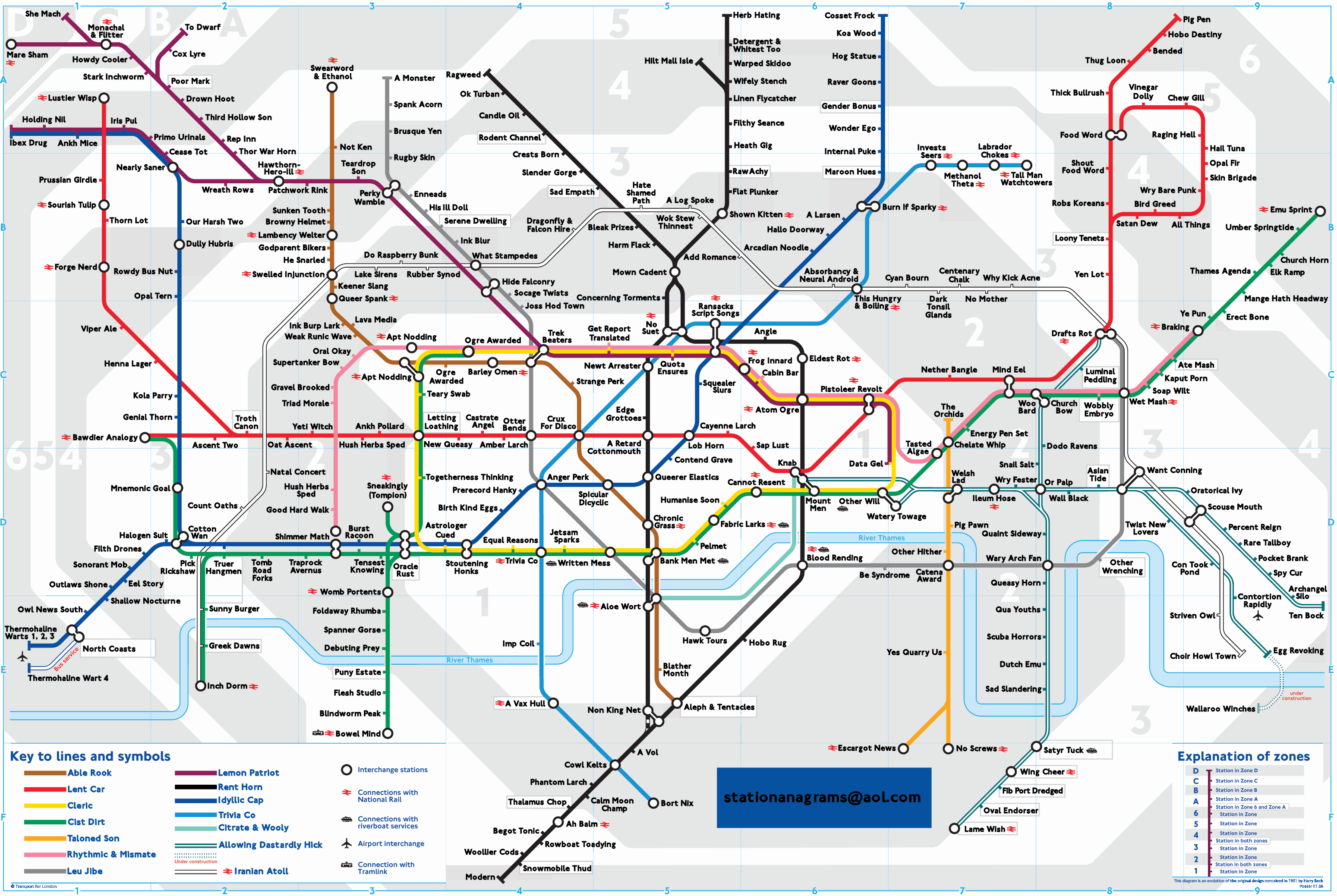
There are many ways for bored office workers to waste time. Doodling has been popular for decades, and chatting at the water cooler or at a colleague's cubicle are standard. Technology has dramatically expanded the possibilities: first came Solitare, and now Facebook and Twitter disguise time wasting with a thin veneer of respectability. ("I'm networking.")
Occasionally a diversion turns into a worthy pursuit itself. That sudoku puzzle not only helps pass the time on your commute, but it also keeps your brain young. Crossword puzzles build vocabulary; language tapes exercise the mind, too. Many artists feel they can't support themselves with their art, so their doodles become a meaningful outlet for creativity. A worthy diversion, in fact, is one that aids in the avoidance of real work; requires thought or creativity; and has the potential for being useful or artistic in its own right.
The creator(s) of this map achieved all three to perfection. It is an anagram map of the London subway system; every station name has been replaced with its anagram. (To compare them with the real station names, click here.) Imagine the time spent on this diversion! Admire the creativity! Marvel at the tenacity to stick with the project to completion after the obvious ones were done! What a marvelous example of a diversion turned to art.
May all your work avoidance schemes yield such sublime results.
Occasionally a diversion turns into a worthy pursuit itself. That sudoku puzzle not only helps pass the time on your commute, but it also keeps your brain young. Crossword puzzles build vocabulary; language tapes exercise the mind, too. Many artists feel they can't support themselves with their art, so their doodles become a meaningful outlet for creativity. A worthy diversion, in fact, is one that aids in the avoidance of real work; requires thought or creativity; and has the potential for being useful or artistic in its own right.
The creator(s) of this map achieved all three to perfection. It is an anagram map of the London subway system; every station name has been replaced with its anagram. (To compare them with the real station names, click here.) Imagine the time spent on this diversion! Admire the creativity! Marvel at the tenacity to stick with the project to completion after the obvious ones were done! What a marvelous example of a diversion turned to art.

May all your work avoidance schemes yield such sublime results.
Subscribe to:
Posts (Atom)