There are many ways for bored office workers to waste time. Doodling has been popular for decades, and chatting at the water cooler or at a colleague's cubicle are standard. Technology has dramatically expanded the possibilities: first came Solitare, and now Facebook and Twitter disguise time wasting with a thin veneer of respectability. ("I'm networking.")
Occasionally a diversion turns into a worthy pursuit itself. That sudoku puzzle not only helps pass the time on your commute, but it also keeps your brain young. Crossword puzzles build vocabulary; language tapes exercise the mind, too. Many artists feel they can't support themselves with their art, so their doodles become a meaningful outlet for creativity. A worthy diversion, in fact, is one that aids in the avoidance of real work; requires thought or creativity; and has the potential for being useful or artistic in its own right.
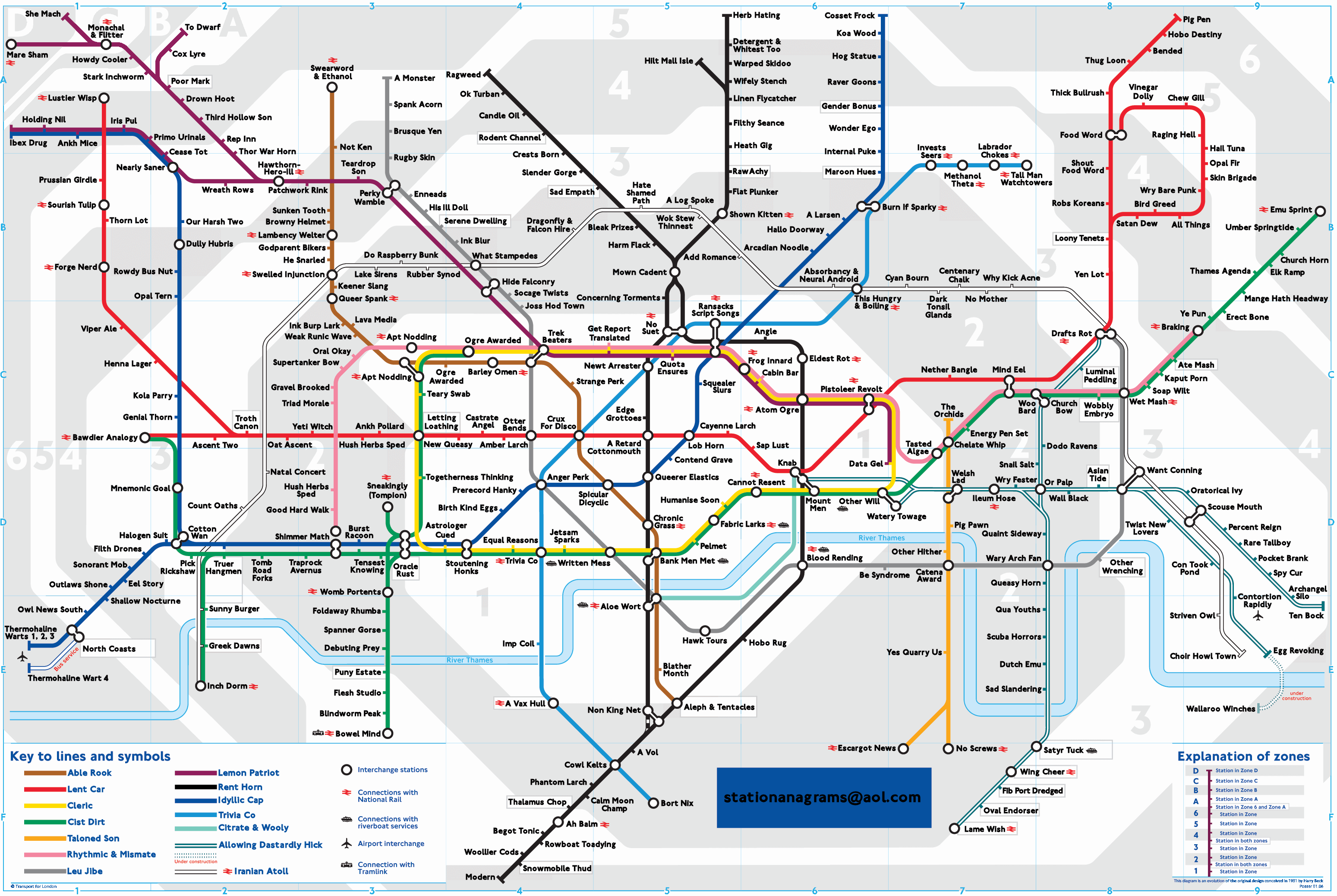
The creator(s) of this map achieved all three to perfection. It is an anagram map of the London subway system; every station name has been replaced with its anagram. (To compare them with the real station names, click here.) Imagine the time spent on this diversion! Admire the creativity! Marvel at the tenacity to stick with the project to completion after the obvious ones were done! What a marvelous example of a diversion turned to art.
May all your work avoidance schemes yield such sublime results.
Wednesday, September 2, 2009



Thursday, August 27, 2009
BOOK REVIEW: "The Elegance of the Hedgehog" by Muriel Barbery
Time is deceptive; that hour you spend stuck in traffic seems a lot longer than the hour you spend on the beach, yet according to the clock, they have the same duration. Time is also valuable; we spend it, save it, or make the most of it whenever we can. But can we make time stand still?
According to Muriel Barbery in her delightful philosophical novel The Elegance of the Hedgehog, time does indeed stand still when there is perfect consonance in the world; indeed, such consonance between what we see and what we feel is what defines Art. Through the thoughts of one of her protagonists, Barbary asserts that great paintings share this ability to stop time, to make us appreciate the exact moment pictured, while forgetting all our own cares and desires. For that moment, we are experiencing "existence without duration."
This is a novel of essays, disguised as thoughts and diary entries of the two primary characters, that cover a diverse set of topics: art, the nature of beauty, our animal natures, and houseplants, to name just a few. (As you might expect of the author of a philosophical novel, Barbery is French, and the novel was originally published in French. The English translation was nicely done by Alison Anderson.) Barbery's diverse musings all follow the same thread: how do we find meaning in our individual lives that are so evidently insignificant in the grand scheme of the universe? What are the little charades that we erect around ourselves to try to convince others, and ourselves, that we matter?
The story follows the inhabitants of a smart Parisian apartment building, in particular two seemingly very different, but in the end quite similar women: Madame Renee Michel, mid-50s, who is the long-time concierge of the building (sort of like the superintendent); and Paloma Josse, 12, a precocious young woman whose family lives on the fifth floor of the building. They know each other only by sight, since the typical posture of an inhabitant of a smart apartment building is to speak to the concierge only when necessary.
Much of the first half of the book is taken up with introducing us to these two characters by way of listening in on thoughts (Mme. Michel) and reading diary pages (young Paloma) that encompass the aforementioned philosophical essays. From this, we conclude that neither woman is what she seems, that both are playing the roles that their circumstances find them occupying. Mme. Michel is careful not to let on to the snobby residents that she is anything more than a simple concierge, while in reality she spends hours reading literature, especially Russian literature, and thinking sophisticated thoughts about life and philosophy. Young Paloma is obviously smart--she is a good student--but her very adult outlook is kept secret from her family, whom she believes to be stupid.
Midway through the novel, the narrative pace picks up as the stable world of the apartment building is turned upside down by the arrival of a new resident, a wealthy Japanese gentleman, who sees beyond the facades of the two women and undertakes to introduce each to her true self. Suddenly the charades are exposed; the careful walls that Renee and Paloma have erected to keep the world out are knocked down by the subtle and measured actions of Monsieur Ozu. That Barbery has done a masterful job of creating her characters through their essays became apparent as I found myself rooting for Monsieur Ozu to keep pressing Renee to knock down another brick, to have the courage to display in public her true nature that has been kept so carefully hidden in her apartment all these years.
Barbery's technique of characterization by essay has its weaknesses, among them that the plot is slow to unfold, leaving the reader wondering at some points early on whether the whole story has come to a stop. Also, the peripheral characters, whose thoughts and diaries we are not privy to, are not as well developed. Even Monsieur Ozu is only a shadow; I was left wondering much about where he came from, and how he got to be so wise as to see in a short time the interesting, intelligent women that so many others had missed.
But these are mere quibbles, for once Monsieur Ozu befriends the two women, the story picks up pace steadily, and our care for Renee and Paloma pulls us right into the stunning denouement. Once the walls are down, we find that the two women, who seemingly had nothing in common other than an address, are soul sisters in a very special way.
Through it all, Barbery challenges us to a new appreciation for the Art of life; for those moments in memory that seem like "existence without duration." Next time you are at a museum, go to a masterpiece painting and stand before it. Gaze at it and notice that you can almost sense what the moment was like that the artist captured, whether it was 50 years ago or 500; it seems as if everything is just where it should be, that it is just as you would have recalled it had you been there. In that moment, you are experiencing existence without duration, and time is, in a way, standing still, since you are sharing that moment with everyone who has ever looked at the painting.
I think about memories I have that share that same sense of being timeless. I think of the birth of each of my children; I don't recall every detail, but the impression in my memory is of a perfect moment--the smile of my wife; the press of her hand in mine; the wet tears striping my cheeks; the jerky first movements of the infant; the excitement of new life. That is a timeless memory; what I saw and what I felt were in perfect consonance; at that moment, life was Art.
May we all find many such moments that add meaning to our otherwise insignificant lives.
According to Muriel Barbery in her delightful philosophical novel The Elegance of the Hedgehog, time does indeed stand still when there is perfect consonance in the world; indeed, such consonance between what we see and what we feel is what defines Art. Through the thoughts of one of her protagonists, Barbary asserts that great paintings share this ability to stop time, to make us appreciate the exact moment pictured, while forgetting all our own cares and desires. For that moment, we are experiencing "existence without duration."
This is a novel of essays, disguised as thoughts and diary entries of the two primary characters, that cover a diverse set of topics: art, the nature of beauty, our animal natures, and houseplants, to name just a few. (As you might expect of the author of a philosophical novel, Barbery is French, and the novel was originally published in French. The English translation was nicely done by Alison Anderson.) Barbery's diverse musings all follow the same thread: how do we find meaning in our individual lives that are so evidently insignificant in the grand scheme of the universe? What are the little charades that we erect around ourselves to try to convince others, and ourselves, that we matter?
The story follows the inhabitants of a smart Parisian apartment building, in particular two seemingly very different, but in the end quite similar women: Madame Renee Michel, mid-50s, who is the long-time concierge of the building (sort of like the superintendent); and Paloma Josse, 12, a precocious young woman whose family lives on the fifth floor of the building. They know each other only by sight, since the typical posture of an inhabitant of a smart apartment building is to speak to the concierge only when necessary.
Much of the first half of the book is taken up with introducing us to these two characters by way of listening in on thoughts (Mme. Michel) and reading diary pages (young Paloma) that encompass the aforementioned philosophical essays. From this, we conclude that neither woman is what she seems, that both are playing the roles that their circumstances find them occupying. Mme. Michel is careful not to let on to the snobby residents that she is anything more than a simple concierge, while in reality she spends hours reading literature, especially Russian literature, and thinking sophisticated thoughts about life and philosophy. Young Paloma is obviously smart--she is a good student--but her very adult outlook is kept secret from her family, whom she believes to be stupid.
Midway through the novel, the narrative pace picks up as the stable world of the apartment building is turned upside down by the arrival of a new resident, a wealthy Japanese gentleman, who sees beyond the facades of the two women and undertakes to introduce each to her true self. Suddenly the charades are exposed; the careful walls that Renee and Paloma have erected to keep the world out are knocked down by the subtle and measured actions of Monsieur Ozu. That Barbery has done a masterful job of creating her characters through their essays became apparent as I found myself rooting for Monsieur Ozu to keep pressing Renee to knock down another brick, to have the courage to display in public her true nature that has been kept so carefully hidden in her apartment all these years.
Barbery's technique of characterization by essay has its weaknesses, among them that the plot is slow to unfold, leaving the reader wondering at some points early on whether the whole story has come to a stop. Also, the peripheral characters, whose thoughts and diaries we are not privy to, are not as well developed. Even Monsieur Ozu is only a shadow; I was left wondering much about where he came from, and how he got to be so wise as to see in a short time the interesting, intelligent women that so many others had missed.
But these are mere quibbles, for once Monsieur Ozu befriends the two women, the story picks up pace steadily, and our care for Renee and Paloma pulls us right into the stunning denouement. Once the walls are down, we find that the two women, who seemingly had nothing in common other than an address, are soul sisters in a very special way.
Through it all, Barbery challenges us to a new appreciation for the Art of life; for those moments in memory that seem like "existence without duration." Next time you are at a museum, go to a masterpiece painting and stand before it. Gaze at it and notice that you can almost sense what the moment was like that the artist captured, whether it was 50 years ago or 500; it seems as if everything is just where it should be, that it is just as you would have recalled it had you been there. In that moment, you are experiencing existence without duration, and time is, in a way, standing still, since you are sharing that moment with everyone who has ever looked at the painting.
I think about memories I have that share that same sense of being timeless. I think of the birth of each of my children; I don't recall every detail, but the impression in my memory is of a perfect moment--the smile of my wife; the press of her hand in mine; the wet tears striping my cheeks; the jerky first movements of the infant; the excitement of new life. That is a timeless memory; what I saw and what I felt were in perfect consonance; at that moment, life was Art.
May we all find many such moments that add meaning to our otherwise insignificant lives.
Saturday, August 22, 2009
When Fast Fails
John Freeman writes thoughtfully in today's Wall Street Journal about the destructive effects of speed on our lives, particularly the relentless speed of communication that we now feel obligated to keep up. Email offers fantastic benefits, of course, but as he points out, those benefits do not come without costs, and he at least gives reason to ponder whether we are near a point where the costs are beginning to exceed the benefits.
My favorite question he asks is this: "How many of our most joyful memories have been created in front of a screen?" My guess is that your answer is the same as mine: none. Yet we spend more and more of our lives in front of screens, from the 24" monitors on our desks to the 2" screens on our phones. The more time we spend staring at screens, the less time we have for creating, building, and sustaining the relationships, experiences, and memories that yield the true wealth of life.
So what will you do this week to reduce your addiction to email? How can you manage your inbox instead of letting it manage you? Let me know your ideas.
My favorite question he asks is this: "How many of our most joyful memories have been created in front of a screen?" My guess is that your answer is the same as mine: none. Yet we spend more and more of our lives in front of screens, from the 24" monitors on our desks to the 2" screens on our phones. The more time we spend staring at screens, the less time we have for creating, building, and sustaining the relationships, experiences, and memories that yield the true wealth of life.
So what will you do this week to reduce your addiction to email? How can you manage your inbox instead of letting it manage you? Let me know your ideas.
Monday, August 17, 2009
The Philosophy of Present Tense Living
Present Tense Living is about appreciating life in the here and now.
Our consumerist society, for all the advantages it offers, has the big disadvantage of relentlessly pulling us toward a promised future of bliss. Happiness is always just one more promotion, or one more purchase, or one more move away. Once we gain something we think we want, our pleasure in the gain often is all too fleeting, as quickly our thoughts turn to the next big thing.
Does the following sound familiar?
You seek to be “happy.” Happy is some combination of health, wealth, and relationships.
Our consumerist society, for all the advantages it offers, has the big disadvantage of relentlessly pulling us toward a promised future of bliss. Happiness is always just one more promotion, or one more purchase, or one more move away. Once we gain something we think we want, our pleasure in the gain often is all too fleeting, as quickly our thoughts turn to the next big thing.
Does the following sound familiar?
You seek to be “happy.” Happy is some combination of health, wealth, and relationships.
So you go to work to earn money. You try to work at something “meaningful” or that somehow contributes more than money to your happiness. Work—and the commute—takes more time than you would like. So you start trying to “save time.”
All this happens against the backdrop of our culture that says you can “have it all.” You can make the most of every opportunity. You can be a great dad, a perfect mom, a smart investor, a buff athlete, a desirable lover, and a dedicated volunteer, all at the same time. It’s hard to fit all that in, but you feel like you should. (After all, the magazines and TV shows say you can and should.) So you sleep a little less. You try to become more “efficient.” You multitask even more. You rush. You hurry. You demand that others do too. (How many times a week do you tell you kids to “Hurry up!”) Welcome to the rat race! You’ve entered the track and you’re well on your way to a life of hurry and scurry.
So: are you happy?
For many people, the answer is: "not exactly." Yes, there are material benefits to our efforts. Yes, the kids are in a good school and get lots of cool stuff. Yes, we have the big house and the big TVs and the big cars. But somehow, we don't feel as happy as, in theory, it seems that we should. Why?
I believe we get so caught up in the rat race--the chase--that we fail to appreciate the milestones that we pass along the way. The idea of present tense living isn't to abandon the race and get off the track; instead, the idea is to slow down and enjoy the route. Notice the buildings along the road; slow down to chat with the spectators lining the way; stop and smell the roses growing in the field beside the turn.
Does that mean you have to give up on winning the race? Perhaps....or perhaps not. (Remember the tortoise and the hare!) I think it is more helpful to redefine "winning": it is not he who crosses the line first, or with the most stuff collected along the way, who wins. Rather, a winning race is a race well run, with a big collection of relationships and experiences enjoyed along the way. Who among us knows how long our race will be, anyway? Better to enjoy it as we run, lest we save all our enjoyment for a future that never comes.
Present Tense Living is about deciding what is important to you, and making that the focus of your life. Don't let a consumerist, materialistic culture decide for you how much to work, and what to spend your money on, and with whom to socialize. Be deliberate about what you will do; do one thing at a time; take time to do it right; enjoy and appreciate the benefits that today offers. Don't ignore the future, but don't be beholden to it either. Live in the present tense!
Tuesday, August 11, 2009
The Background of Present Tense Living
I've just spent two weeks of vacation in the Smoky Mountains during which I did no writing, but did do lots of thinking about writing. Specifically, while gazing at distant peaks, I found myself inspired to return to first principles and describe, for myself and my readers, just what I mean by "Present Tense Living" and what is the philosophy that drives my musings.
But before I set forth the philosophy, I think it will be helpful to provide the background for my thinking about matters of time and life. It is now a trite observation that life in the 21st century moves very, very fast. The immediacy with which we can communicate, research, and share information would be unthinkable to anyone living just 75 years ago. With current technology we can do more work, alone, from our living rooms than our grandfathers could do in their offices with an assistant or two at their disposal.
And as these things seem to go, once we CAN do work anywhere, it quickly becomes the norm that we SHOULD do work anywhere. The pressure to be always available, productive, and active is relentless, both from our employers and from our families, friends, and even ourselves. We can do more in less time, the thinking goes, which is unquestionably good because if we do more, we can have more, and then we will be happy.
As I pointed out in this early post, I was eventually struck by the fact that all my busyness wasn't necessarily directed at things I meant to be, or wanted to be, doing. And the more I thought about it, the more I realized that a lot of the busyness was a front; that in a culture that worships work, to appear NOT to be busy is to be a misfit, a "nerd," as it were. Plus, if the do more=have more=be happy equation holds, then all the busy people around me should be very happy. Yet, my own observations of my friends and colleagues, plus anecdotal evidence from articles and surveys, shows that Americans as a whole aren't any happier now than they were 40 years ago. Could it be that the entire premise under which we are all living is false?
So, against this background of pressure to constantly do more, to be better, to have it all, I began wondering if there was another way. I eventually realized that all this searching for the next big thing, for the key to happiness, caused me constantly to be living in the future. (Once I get _______, then....." or, "As soon as I finish_______, then........") On the other hand, when things didn't go just right, the thing to do was search my past for something or someone to blame. ("If my parents hadn't _______, then.....", or "If my old boss had only _________, then......") In essence, like most people, I was always either looking forward or backward--anywhere but in the here and now, appreciating what I had today. I began wondering: how much of life right around us do we miss, because we are scanning the horizon in front of us or behind us looking for something else? What if I could learn to live in the present, appreciating and enjoying the world around me, today, and what I already have rather than getting caught up in the constant scramble for more, more, more? Perhaps that could be a happier existence, even if it meant doing less or having less over the long run.
Thus began my reading, thinking, and writing about life in these fast-moving times, and how to "live in the present tense." Over the next few posts I'll outline my philosophy as it exists today, based on my reading and writing and thinking so far. Some of it will be new, some of it is just explicitly stating some of the principles I've already referred to in this blog. You may agree with it or think I'm crazy, but I hope to at least encourage you to think about why you are doing what you are doing, and whether it is the best way to live a full life. Let me know what you think.
But before I set forth the philosophy, I think it will be helpful to provide the background for my thinking about matters of time and life. It is now a trite observation that life in the 21st century moves very, very fast. The immediacy with which we can communicate, research, and share information would be unthinkable to anyone living just 75 years ago. With current technology we can do more work, alone, from our living rooms than our grandfathers could do in their offices with an assistant or two at their disposal.
And as these things seem to go, once we CAN do work anywhere, it quickly becomes the norm that we SHOULD do work anywhere. The pressure to be always available, productive, and active is relentless, both from our employers and from our families, friends, and even ourselves. We can do more in less time, the thinking goes, which is unquestionably good because if we do more, we can have more, and then we will be happy.
As I pointed out in this early post, I was eventually struck by the fact that all my busyness wasn't necessarily directed at things I meant to be, or wanted to be, doing. And the more I thought about it, the more I realized that a lot of the busyness was a front; that in a culture that worships work, to appear NOT to be busy is to be a misfit, a "nerd," as it were. Plus, if the do more=have more=be happy equation holds, then all the busy people around me should be very happy. Yet, my own observations of my friends and colleagues, plus anecdotal evidence from articles and surveys, shows that Americans as a whole aren't any happier now than they were 40 years ago. Could it be that the entire premise under which we are all living is false?
So, against this background of pressure to constantly do more, to be better, to have it all, I began wondering if there was another way. I eventually realized that all this searching for the next big thing, for the key to happiness, caused me constantly to be living in the future. (Once I get _______, then....." or, "As soon as I finish_______, then........") On the other hand, when things didn't go just right, the thing to do was search my past for something or someone to blame. ("If my parents hadn't _______, then.....", or "If my old boss had only _________, then......") In essence, like most people, I was always either looking forward or backward--anywhere but in the here and now, appreciating what I had today. I began wondering: how much of life right around us do we miss, because we are scanning the horizon in front of us or behind us looking for something else? What if I could learn to live in the present, appreciating and enjoying the world around me, today, and what I already have rather than getting caught up in the constant scramble for more, more, more? Perhaps that could be a happier existence, even if it meant doing less or having less over the long run.
Thus began my reading, thinking, and writing about life in these fast-moving times, and how to "live in the present tense." Over the next few posts I'll outline my philosophy as it exists today, based on my reading and writing and thinking so far. Some of it will be new, some of it is just explicitly stating some of the principles I've already referred to in this blog. You may agree with it or think I'm crazy, but I hope to at least encourage you to think about why you are doing what you are doing, and whether it is the best way to live a full life. Let me know what you think.
Tuesday, July 14, 2009
Ways to Slow Down
Is it just me, or do people seem to be rushed more than ever this summer? I would have thought that things would be moving at a more languid pace given the macroeconomic slowdown, and indeed my friends who have been laid off from their jobs are indeed forced to move more slowly, since they have nowhere to go. But for the majority of my acquaintances who still have jobs, the microeconomic effect of the recession seems to actually be to speed things up.
Offices are doing more with less, meaning the people left behind are swamped. Some people have had hours or pay reduced and so are working an extra job to try to make up the income. Some companies still have aggressive growth targets in the face of the recession, and so workers are having to press harder to try to make the targets. Whatever the cause, it seems the world is speeding up even more than it had been even a few months ago.
Add pressure of financial setback--whether in reduced salary, or loss of bonus, or the fall in 401k or college fund value--and it can feel like you have to run even faster just to keep up. Speed can be beneficial, of course, but speed also kills. In emotional terms, it is the stress that speed creates that can lead to emotional breakdowns, health problems, and neglected relationships. Dealing with that stress thus becomes a vital skill, on par with the finance, or marketing, or human resources, or programming, or whatever skills you need to excel at your job.
I don't have all the answers for dealing with stress, and different people will find different solutions that work for them. But the main theme of the stress reduction techniques that work for me is this: Slow Down! Here are some ways I do it:
1. Do Less. If job or school pressures have increased, our tendency is to add the new responsibilities to our previous list and try to cram it all into our already-harried lives. If I try to do that, it guarantees mediocrity. So, when I start to feel the stress of too much to do, I prioritize and cut out one or two activities at the bottom of the list. If I'm already down to my core activities, then I look for ways to do them more efficiently, like changing a client meeting from a visit (requiring travel time in addition to meeting time) to a conference call. But realistically, there are always one or two activities that I can cut out without affecting my job or my family.
2. Set priorities. Even after I've culled my activities, my daily to-do list is often long. So I next look at it with a focus on deadlines: what MUST be done by today or tomorrow? I then do those things first, to make sure they get done. Some tasks have very clear deadlines: if I have a client meeting tomorrow, then I know I've got to finish my presentation by the end of the day today. It must be my priority. I like what Merlin Mann has written about priorities: "true priorities are like arms; if you think you have more than one or two, you're either lying or crazy." There are lots of things that are important to me, but on any given day there are very few must-do priorities. If I'm honest about what HAS TO be done today, and do that first, then my stress level goes down.
3. Don't forget to live. For me, that means don't skip meals and breaks. I may not linger over a three course lunch, but I will still leave my desk, walk outside with a sandwich, and take a 20- or 30-minute break from my tasks. Better yet if I can get someone to go with me so that I can have a human conversation, preferably about something other than the task I'm working on. I return from these breaks refreshed and ready to work again. And only very rarely will I not stop at an appropriate time and go home to eat dinner with my family. Again, the interaction with other people, the break from the monotony of a task, the reminder of life outside of work, far from being a waste of time, actually makes my work better. Remember, we are working to live, not living to work. Don't shortchange your life, and your work will be better.
DO LESS is probably not the advice you would expect, but it works wonders for me. What do you do to manage the stress of the modern world?
Offices are doing more with less, meaning the people left behind are swamped. Some people have had hours or pay reduced and so are working an extra job to try to make up the income. Some companies still have aggressive growth targets in the face of the recession, and so workers are having to press harder to try to make the targets. Whatever the cause, it seems the world is speeding up even more than it had been even a few months ago.
Add pressure of financial setback--whether in reduced salary, or loss of bonus, or the fall in 401k or college fund value--and it can feel like you have to run even faster just to keep up. Speed can be beneficial, of course, but speed also kills. In emotional terms, it is the stress that speed creates that can lead to emotional breakdowns, health problems, and neglected relationships. Dealing with that stress thus becomes a vital skill, on par with the finance, or marketing, or human resources, or programming, or whatever skills you need to excel at your job.
I don't have all the answers for dealing with stress, and different people will find different solutions that work for them. But the main theme of the stress reduction techniques that work for me is this: Slow Down! Here are some ways I do it:
1. Do Less. If job or school pressures have increased, our tendency is to add the new responsibilities to our previous list and try to cram it all into our already-harried lives. If I try to do that, it guarantees mediocrity. So, when I start to feel the stress of too much to do, I prioritize and cut out one or two activities at the bottom of the list. If I'm already down to my core activities, then I look for ways to do them more efficiently, like changing a client meeting from a visit (requiring travel time in addition to meeting time) to a conference call. But realistically, there are always one or two activities that I can cut out without affecting my job or my family.
2. Set priorities. Even after I've culled my activities, my daily to-do list is often long. So I next look at it with a focus on deadlines: what MUST be done by today or tomorrow? I then do those things first, to make sure they get done. Some tasks have very clear deadlines: if I have a client meeting tomorrow, then I know I've got to finish my presentation by the end of the day today. It must be my priority. I like what Merlin Mann has written about priorities: "true priorities are like arms; if you think you have more than one or two, you're either lying or crazy." There are lots of things that are important to me, but on any given day there are very few must-do priorities. If I'm honest about what HAS TO be done today, and do that first, then my stress level goes down.
3. Don't forget to live. For me, that means don't skip meals and breaks. I may not linger over a three course lunch, but I will still leave my desk, walk outside with a sandwich, and take a 20- or 30-minute break from my tasks. Better yet if I can get someone to go with me so that I can have a human conversation, preferably about something other than the task I'm working on. I return from these breaks refreshed and ready to work again. And only very rarely will I not stop at an appropriate time and go home to eat dinner with my family. Again, the interaction with other people, the break from the monotony of a task, the reminder of life outside of work, far from being a waste of time, actually makes my work better. Remember, we are working to live, not living to work. Don't shortchange your life, and your work will be better.
DO LESS is probably not the advice you would expect, but it works wonders for me. What do you do to manage the stress of the modern world?
Monday, July 6, 2009
Understanding the Amish
It turns out the Amish, who outwardly seem so different from the rest of us, may not be so different after all. This article in the Wall Street Journal last week describes the Amish community in northern Indiana that partially joined modern society by taking jobs in the region's RV factories during the boom years in the middle of this decade. The result? For many, an increase in debt; a weakening of the traditional community ties, replaced by a more assertive individualism; and conspicuous consumption. (I would love to see one of the horse-drawn buggies with LED lights--who would have thought there would be a way to "pimp my buggy"?)
I think the article reflects more on mainstream American culture than on Amish culture. Take adults who have been raised outside our culture and drop them in, and what happens? The urge to spend takes hold almost immediately. Spending more then causes selfishness, as the list of wants exceeds the available cash, and so generosity and community-mindedness suffers; plus, now that work is so necessary to earn the money to buy the stuff, time is hoarded for selfish pursuits instead of community pursuits. Finally, the need to show the world this new bargain one has made (trading work for money and stuff) leads to pride and the purchase of "positional goods"--stuff that displays one's new status to others. The process is very clear in the case of the Amish, because they started outside of the culture and were thrown into it. But what about those of us who were raised in it?
It is very, very difficult to break the habits that your cultural upbringing has left you with. We are subject to the same cultural pressures: the focus on material things as a sign of success; the pressure to buy stuff to display our economic status; the push to work harder and longer to be able to afford more of the stuff to impress the people around us. To us this is "normal", and thus very, very hard to break out of. Unlike the Amish, we have no other community to go back to, no community organized under principles of collective living and modest consumption. If we so choose, we have to go it almost alone in living counter to the prevailing ethos. That makes it very, very difficult to adopt a lifestyle that avoids overwrought consumption.
I think the article reflects more on mainstream American culture than on Amish culture. Take adults who have been raised outside our culture and drop them in, and what happens? The urge to spend takes hold almost immediately. Spending more then causes selfishness, as the list of wants exceeds the available cash, and so generosity and community-mindedness suffers; plus, now that work is so necessary to earn the money to buy the stuff, time is hoarded for selfish pursuits instead of community pursuits. Finally, the need to show the world this new bargain one has made (trading work for money and stuff) leads to pride and the purchase of "positional goods"--stuff that displays one's new status to others. The process is very clear in the case of the Amish, because they started outside of the culture and were thrown into it. But what about those of us who were raised in it?
It is very, very difficult to break the habits that your cultural upbringing has left you with. We are subject to the same cultural pressures: the focus on material things as a sign of success; the pressure to buy stuff to display our economic status; the push to work harder and longer to be able to afford more of the stuff to impress the people around us. To us this is "normal", and thus very, very hard to break out of. Unlike the Amish, we have no other community to go back to, no community organized under principles of collective living and modest consumption. If we so choose, we have to go it almost alone in living counter to the prevailing ethos. That makes it very, very difficult to adopt a lifestyle that avoids overwrought consumption.
Subscribe to:
Posts (Atom)